By UpdateSTL.com • August 2026• 15–17 min read
Last reviewed: August 2026
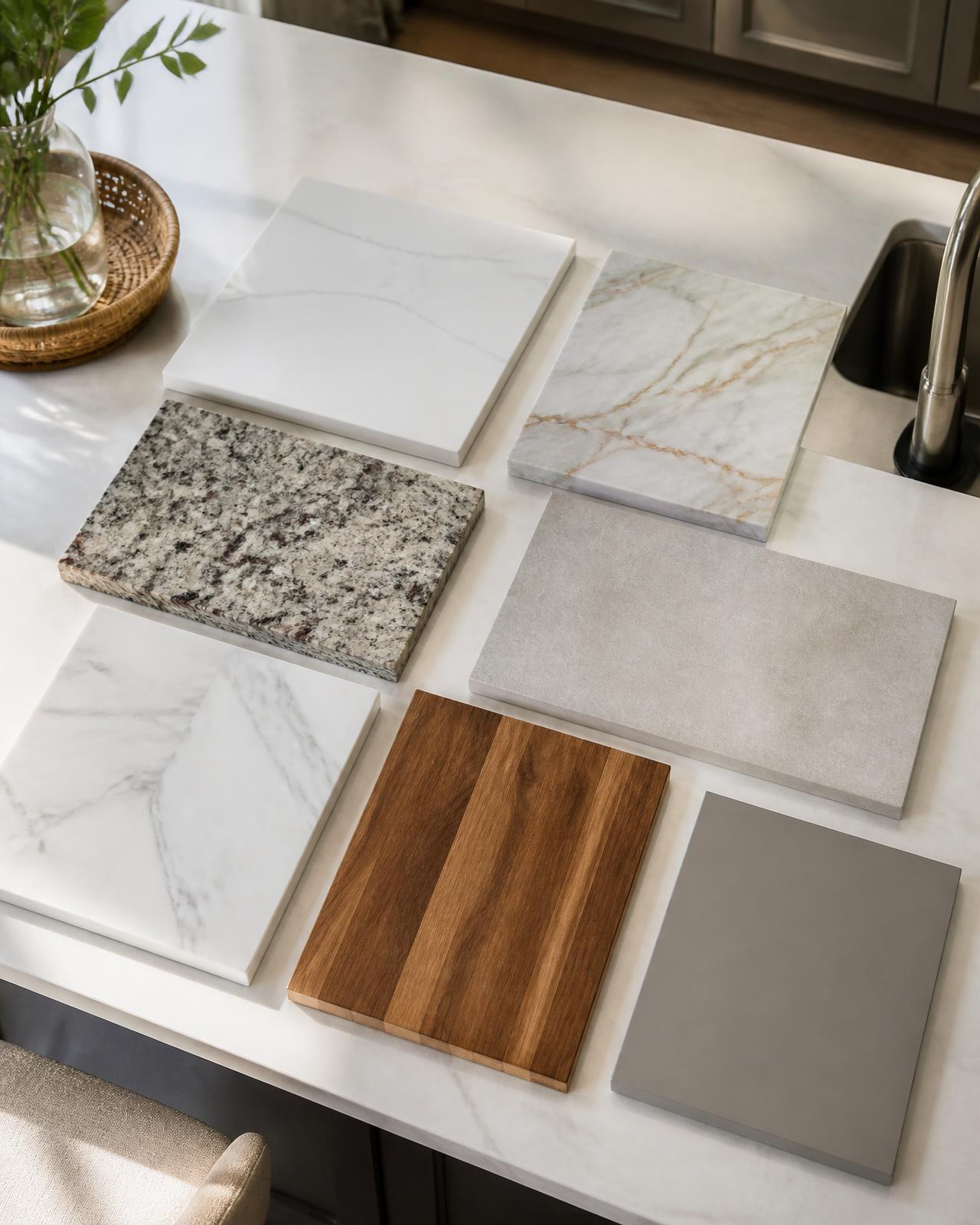
The countertop sample is only a few inches wide.
The finished countertop may cover an island, sink run, range wall, beverage area, pantry, and backsplash.
That difference matters.
A small sample can show color. It cannot fully show pattern movement, slab variation, seams, edge profiles, reflections, maintenance, heat behavior, fabrication limitations, or how the surface will look beside the cabinets and flooring.
That is why the question “What is the best material for kitchen countertops?” rarely has one correct answer.
The best countertop for a household that cooks heavily may not be the best choice for a homeowner who wants the lowest maintenance. The best material for a high-end statement island may not be the right material for a rental, a resale-focused remodel, or a kitchen designed around a strict budget.
A countertop must do several jobs at once:
- Handle daily use
- Support food preparation
- Work with sinks and appliances
- Coordinate with cabinets, backsplash, flooring, and lighting
- Fit the level of finish
- Meet the household's maintenance expectations
- Be fabricatable in the actual layout
- Stay within the project budget
In 2026, quartz and natural quartzite remain prominent, while porcelain and sintered surfaces continue to attract attention. Granite, marble, butcher block, solid surface, laminate, soapstone, and concrete still have legitimate places in the right kitchen.
The goal of this guide is not to crown one winner.
It is to help homeowners identify the tradeoff they are willing to live with.
The best countertop is the one whose strengths matter to you — and whose limitations you are prepared to manage.
Start With the Questions That Actually Matter
Before looking at colors, answer these questions:
- How heavily is the kitchen used?
- Are hot cookware and countertop appliances common?
- Are spills cleaned immediately or later?
- Is regular sealing acceptable?
- Are natural variation and patina desirable or frustrating?
- Does the design require a waterfall edge or full-height slab backsplash?
- How visible will seams be?
- Is the island large enough to require more than one slab?
- Are integrated sinks or seamless transitions important?
- Is the project practical, updated, or custom in finish level?
- Will the homeowner stay long term or sell soon?
- Does the material match the home's value and neighborhood?
Those answers narrow the field more effectively than a list of trendy colors.
The 2026 Countertop Direction
Current kitchen research points toward warmer, more natural-looking interiors.
NKBA's 2026 Kitchen Trends Report says natural materials, organic neutrals, wood grain, quartz, and natural quartzite are prominent. Houzz's 2026 kitchen research shows transitional design remains the leading style among homeowners changing the look of their kitchens, with strong interest in built-in storage and task-specific features.
That creates several visible countertop trends:
- Warm whites instead of icy white
- Cream, taupe, beige, and soft brown undertones
- Natural movement rather than repetitive small patterns
- Quartzite-inspired engineered designs
- Honed, matte, or softly textured appearances
- Full-height slab backsplashes
- Waterfall countertop ends on selected islands
- Mixed materials, such as stone perimeter counters with a butcher block work zone
- Thicker-looking mitered edges used selectively
- Fewer competing patterns in the same room
A trend can guide the mood. It should not override performance and budget.
Quartz Countertops
Quartz countertops are engineered surfaces made from quartz, minerals, pigments, glass in some products, and resin binders.
Why Homeowners Choose Quartz
- Nonporous surface
- No routine sealing required for many products
- Consistent colors and patterns
- Wide selection of marble- and quartzite-inspired designs
- Strong resistance to everyday stains
- Easier matching across multiple slabs than many natural stones
- Predictable appearance for large kitchens
- Broad availability
Quartz is often the practical answer for homeowners who want a stone-like appearance without routine natural-stone sealing.
What to Consider
Quartz contains resin. Manufacturers generally recommend protecting the surface from extreme or sustained heat and using trivets or hot pads. Product guidance can vary, so the specific manufacturer's care instructions and warranty should control.
Quartz can also look too uniform for homeowners who want the depth and variation of natural stone. On bold veined designs, seams and pattern matching still require careful planning.
Best Fit
Quartz can be a strong fit for:
- Busy family kitchens
- Homeowners prioritizing low maintenance
- Large projects needing visual consistency
- Transitional or modern designs
- Resale-focused remodels with broad appeal
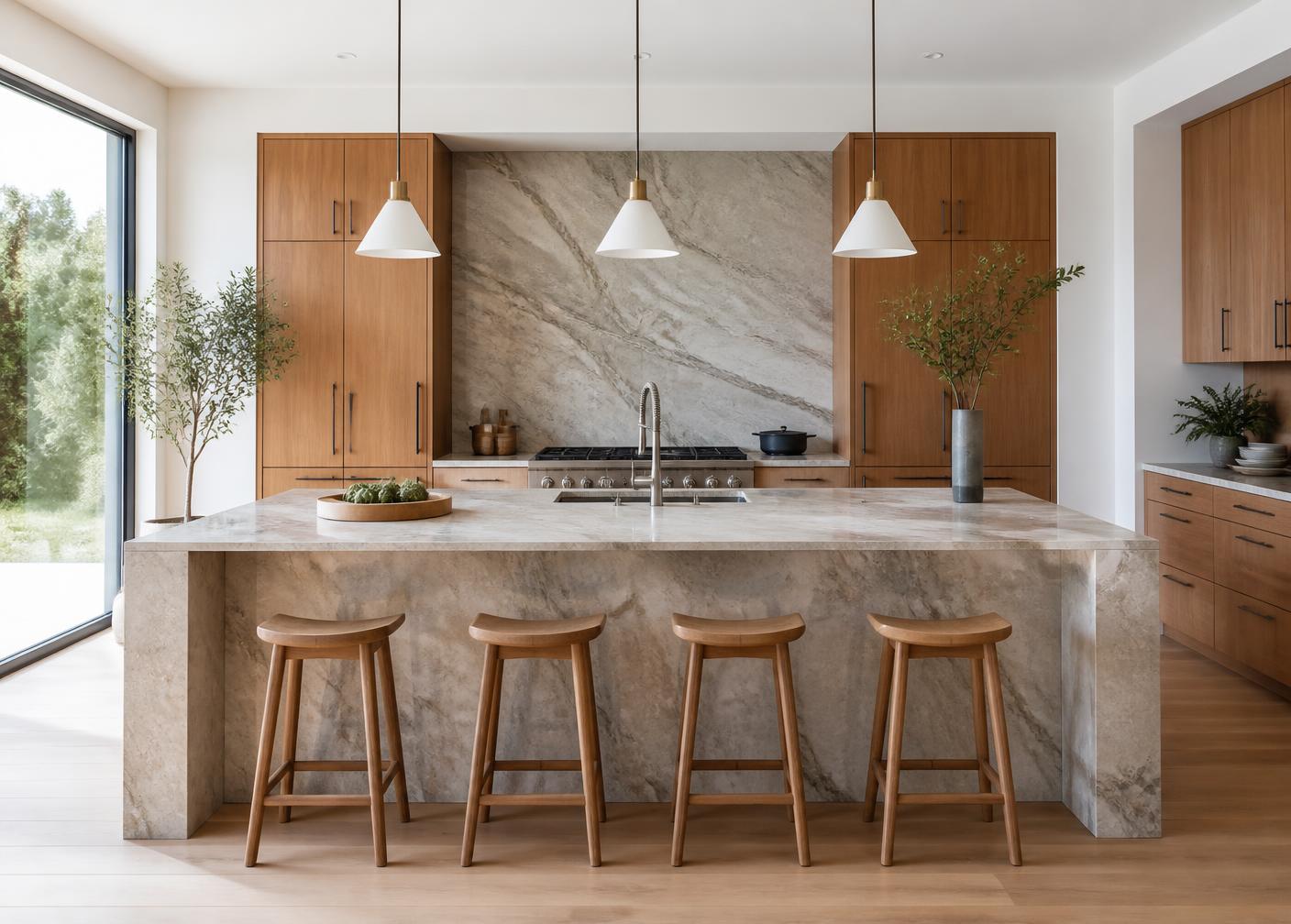
Natural Quartzite Countertops
Quartzite is a natural metamorphic stone formed from sandstone under heat and pressure. It is not the same product as engineered quartz.
Why Homeowners Choose Quartzite
- Natural, one-of-a-kind movement
- High-end visual character
- Many slabs resemble marble while offering a different performance profile
- Strong fit with natural wood cabinetry and warm 2026 palettes
- Excellent statement material for islands and full-height backsplashes
- Each slab is unique
Quartzite can give a kitchen depth that printed or engineered patterns may not fully reproduce.
What to Consider
Natural stone varies. Some materials sold under trade names may behave differently, so the slab should be accurately identified and evaluated by a qualified stone supplier or fabricator.
Quartzite generally requires stone-specific care and may need sealing based on the stone and fabricator recommendations. Natural fissures, veins, mineral deposits, shade changes, and texture are part of the material rather than manufacturing defects.
Slab selection is critical. Homeowners should view the actual slabs, not only a small sample.
Best Fit
Quartzite can be a strong fit for:
- High-value and custom kitchens
- Homeowners who want natural variation
- Warm wood and organic-material designs
- Statement islands
- Long-term owners willing to follow natural-stone care guidance
Read What Does Level of Finish Mean in a Remodel? before deciding whether a premium stone matches the property and project goals.
Granite Countertops
Granite is a natural igneous stone available in a broad range of colors, grain structures, movements, and finishes.
Why Homeowners Choose Granite
- Natural stone character
- Broad product selection
- Strong durability when appropriately selected, fabricated, installed, and maintained
- Good heat tolerance compared with resin-based surfaces
- Unique slabs
- Established fabrication and supply network
Granite is sometimes described as outdated because certain speckled colors were heavily used in previous decades. That is a design issue, not a material failure. Many current granites have quieter movement, warmer tones, leathered textures, or dramatic patterns that fit modern kitchens.
What to Consider
Granite porosity varies, and sealing recommendations depend on the specific stone. Pattern movement and seams should be reviewed. Edge and corner impacts can damage any stone surface, especially around sink or cooktop cutouts.
Best Fit
Granite may suit:
- Homeowners who want natural stone
- Kitchens requiring good heat tolerance
- Traditional, transitional, or organic designs
- Projects where an available slab provides excellent value
Marble Countertops
Marble is a natural stone known for elegant veining and depth.
Why Homeowners Choose Marble
- Classic appearance
- Natural movement
- Strong association with traditional and high-end design
- Excellent work surface for some baking applications
- Develops a natural patina over time
What to Consider
Marble is sensitive to acids and can etch. It can also stain and scratch. Sealing may reduce stain absorption but does not prevent acid etching.
A homeowner who wants marble to remain visually unchanged may be disappointed. A homeowner who accepts patina as part of the material may love it for decades.
Best Fit
Marble may suit:
- Homeowners who value natural beauty over pristine perfection
- Baking areas
- Butler's pantries or selected accent surfaces
- Traditional or custom kitchens
- Long-term owners comfortable with patina
Porcelain and Sintered-Surface Countertops
Large-format porcelain and related sintered surfaces are manufactured under heat and pressure. Product composition and performance vary by brand.
Why Homeowners Choose Porcelain
- Strong heat resistance in many products
- Strong scratch and stain resistance
- Thin slab profiles
- UV-resistant options for some outdoor applications
- Natural-stone-inspired visuals
- Low routine maintenance
- Ability to continue the material onto walls or backsplashes
Porcelain is particularly attractive for full-height backsplashes and contemporary designs where a thinner, crisp profile is desired.
What to Consider
The material can be very hard yet vulnerable to edge impact or chipping if mishandled. Fabrication requires appropriate equipment and experience. Thin slabs may use mitered edge construction to create a thicker visual profile. Pattern matching and printed-surface depth should be reviewed in person.
Best Fit
Porcelain may suit:
- Modern and transitional kitchens
- Full-height slab backsplash designs
- Homeowners prioritizing heat and stain resistance
- Indoor-outdoor design continuity where the product is approved
- Minimalist edge profiles
Soapstone Countertops
Soapstone is a natural metamorphic stone with a smooth, soft feel and distinctive darkening over time.
Why Homeowners Choose Soapstone
- Natural, understated appearance
- Strong resistance to heat
- Nonporous characteristics
- Patina and age can add character
- Scratches may often be sanded or blended depending on the finish
- Works well in historic, traditional, and organic kitchens
What to Consider
Soapstone is softer than many stones and will scratch or dent more readily. Some homeowners oil or wax it to create a darker, more uniform appearance; others allow it to age naturally.
Best Fit
Soapstone may suit:
- Historic St. Louis homes
- Homeowners who appreciate patina
- Dark, understated counter designs
- Kitchens where heat tolerance matters
- Accent sections or full kitchens with a handcrafted character
Butcher Block Countertops
Butcher block is made from bonded wood strips or blocks. Species, grain orientation, finish, and construction method affect performance.
Why Homeowners Choose Butcher Block
- Warm natural appearance
- Softer visual and tactile contrast to stone
- Can be refinished in many cases
- Works well on islands, baking stations, or selected zones
- Broad range of wood species and tones
- Can make a large kitchen feel less cold
The term “butcherblock” often refers to many different products, from affordable wood tops to premium custom end-grain surfaces. They should not be treated as identical.
What to Consider
Wood moves with moisture. Sink cutouts, seams, dishwashers, and wet areas require careful fabrication and maintenance. The finish system determines whether the surface is intended for direct cutting or simply decorative use. Heat, standing water, and neglected maintenance can damage it.
Best Fit
Butcher block may suit:
- Islands and dedicated prep zones
- Warm transitional kitchens
- Homeowners comfortable with maintenance
- Mixed-material countertop designs
- Projects seeking natural texture at a controlled budget
Solid-Surface Countertops
Solid-surface materials, including Corian and similar products, are manufactured acrylic or polyester-based surfaces.
Why Homeowners Choose Solid Surface
- Nonporous material
- Virtually seamless appearance in many layouts
- Integrated sinks and coved backsplashes may be possible
- Scratches and damage may often be repaired or renewed by qualified fabricators
- Wide color selection
- Softer visual appearance than many stones
What to Consider
Solid surface can scratch and may be damaged by heat. It usually does not reproduce the depth of natural stone, though newer patterns have improved substantially.
Best Fit
Solid surface may suit:
- Homeowners prioritizing seamless, easy-clean transitions
- Accessible or aging-in-place kitchens
- Integrated sink designs
- Contemporary or practical remodels
- Projects where future repairability matters
Laminate Countertops
Laminate is a decorative surface bonded to a substrate.
Why Homeowners Choose Laminate
- Lower initial cost
- Broad range of colors and patterns
- Fast visual update
- Lighter weight
- Suitable for practical, rental, resale-prep, or phased projects
- Improved high-definition patterns compared with older products
What to Consider
Laminate is not impervious to heat, scratches, water intrusion at seams, or edge damage. Manufacturers recommend trivets and cutting boards. Undermount sink options and edge treatments may be more limited than with stone or solid surface.
Best Fit
Laminate may suit:
- Budget-conscious remodels
- Rentals
- Temporary or phased kitchens
- Laundry rooms and utility spaces
- Homeowners who value easy replacement over permanence
Concrete Countertops
Concrete countertops may be cast in place or precast by specialty fabricators.
Why Homeowners Choose Concrete
- Custom shape and thickness
- Integral colors and textures
- Industrial or artisan appearance
- Potential for integrated drainboards or unique details
- Highly personalized result
What to Consider
Concrete can crack, stain, etch, and develop visual variation. Sealer performance and maintenance are critical. Weight, support, fabrication skill, and cure time can affect the project.
Best Fit
Concrete may suit:
- Custom industrial or modern kitchens
- Homeowners who embrace variation and patina
- Highly personalized projects
- Specialty islands or accent areas
A Side-by-Side Countertop Comparison
| Material | Primary strength | Main limitation | Routine sealing | Heat approach | Visual character | Typical project fit |
|---|---|---|---|---|---|---|
| Quartz | Nonporous, consistent, broad design range | Protect from extreme or sustained heat; engineered appearance varies | Generally no | Use trivets per manufacturer | Controlled patterns from subtle to dramatic | Practical through high-end |
| Quartzite | Natural movement and premium stone character | Slab variation and stone-specific care | Often recommended based on stone | Strong natural-stone heat tolerance, but use protection | One-of-a-kind | Updated to custom/high-end |
| Granite | Durable natural stone with broad variety | Porosity, pattern, and sealing vary | Depends on stone | Generally good, but protection is still wise | Natural grain or movement | Midrange through high-end |
| Marble | Classic veining and depth | Etching, staining, scratching, and patina | Commonly recommended | Use protection | Elegant, natural, changes with use | Specialty or custom |
| Porcelain | Heat, stain, scratch, and UV performance in many products | Edge vulnerability and specialized fabrication | Generally no | Strong, follow product instructions | Printed natural-stone or modern looks | Updated through custom |
| Soapstone | Heat resistance, nonporous character, patina | Softer and scratches more readily | No conventional sealer; oil/wax optional | Strong | Dark, quiet, historic | Specialty and custom |
| Butcher block | Warmth and repairable wood character | Moisture, heat, and maintenance sensitivity | Finish-dependent | Use trivets | Natural wood | Accent, practical, or custom |
| Solid surface | Seamless options and repairability | Scratch and heat sensitivity | No | Use trivets | Uniform to softly patterned | Practical through updated |
| Laminate | Affordability and broad selection | Heat, scratch, seam, and edge limitations | No | Always use protection | Printed patterns | Budget and practical |
| Concrete | Custom shape and artisan character | Cracking, staining, weight, and sealer maintenance | Usually | Product/sealer dependent | Handcrafted variation | Custom specialty |
Quartz
- Primary strength
- Nonporous, consistent, broad design range
- Main limitation
- Protect from extreme or sustained heat; engineered appearance varies
- Routine sealing
- Generally no
- Heat approach
- Use trivets per manufacturer
- Visual character
- Controlled patterns from subtle to dramatic
- Typical project fit
- Practical through high-end
Quartzite
- Primary strength
- Natural movement and premium stone character
- Main limitation
- Slab variation and stone-specific care
- Routine sealing
- Often recommended based on stone
- Heat approach
- Strong natural-stone heat tolerance, but use protection
- Visual character
- One-of-a-kind
- Typical project fit
- Updated to custom/high-end
Granite
- Primary strength
- Durable natural stone with broad variety
- Main limitation
- Porosity, pattern, and sealing vary
- Routine sealing
- Depends on stone
- Heat approach
- Generally good, but protection is still wise
- Visual character
- Natural grain or movement
- Typical project fit
- Midrange through high-end
Marble
- Primary strength
- Classic veining and depth
- Main limitation
- Etching, staining, scratching, and patina
- Routine sealing
- Commonly recommended
- Heat approach
- Use protection
- Visual character
- Elegant, natural, changes with use
- Typical project fit
- Specialty or custom
Porcelain
- Primary strength
- Heat, stain, scratch, and UV performance in many products
- Main limitation
- Edge vulnerability and specialized fabrication
- Routine sealing
- Generally no
- Heat approach
- Strong, follow product instructions
- Visual character
- Printed natural-stone or modern looks
- Typical project fit
- Updated through custom
Soapstone
- Primary strength
- Heat resistance, nonporous character, patina
- Main limitation
- Softer and scratches more readily
- Routine sealing
- No conventional sealer; oil/wax optional
- Heat approach
- Strong
- Visual character
- Dark, quiet, historic
- Typical project fit
- Specialty and custom
Butcher block
- Primary strength
- Warmth and repairable wood character
- Main limitation
- Moisture, heat, and maintenance sensitivity
- Routine sealing
- Finish-dependent
- Heat approach
- Use trivets
- Visual character
- Natural wood
- Typical project fit
- Accent, practical, or custom
Solid surface
- Primary strength
- Seamless options and repairability
- Main limitation
- Scratch and heat sensitivity
- Routine sealing
- No
- Heat approach
- Use trivets
- Visual character
- Uniform to softly patterned
- Typical project fit
- Practical through updated
Laminate
- Primary strength
- Affordability and broad selection
- Main limitation
- Heat, scratch, seam, and edge limitations
- Routine sealing
- No
- Heat approach
- Always use protection
- Visual character
- Printed patterns
- Typical project fit
- Budget and practical
Concrete
- Primary strength
- Custom shape and artisan character
- Main limitation
- Cracking, staining, weight, and sealer maintenance
- Routine sealing
- Usually
- Heat approach
- Product/sealer dependent
- Visual character
- Handcrafted variation
- Typical project fit
- Custom specialty
Performance varies by product, finish, fabrication, installation, and care. Always follow the manufacturer, supplier, and fabricator guidance for the exact surface selected.
Quartz Versus Quartzite
These two names create more confusion than any other countertop comparison.
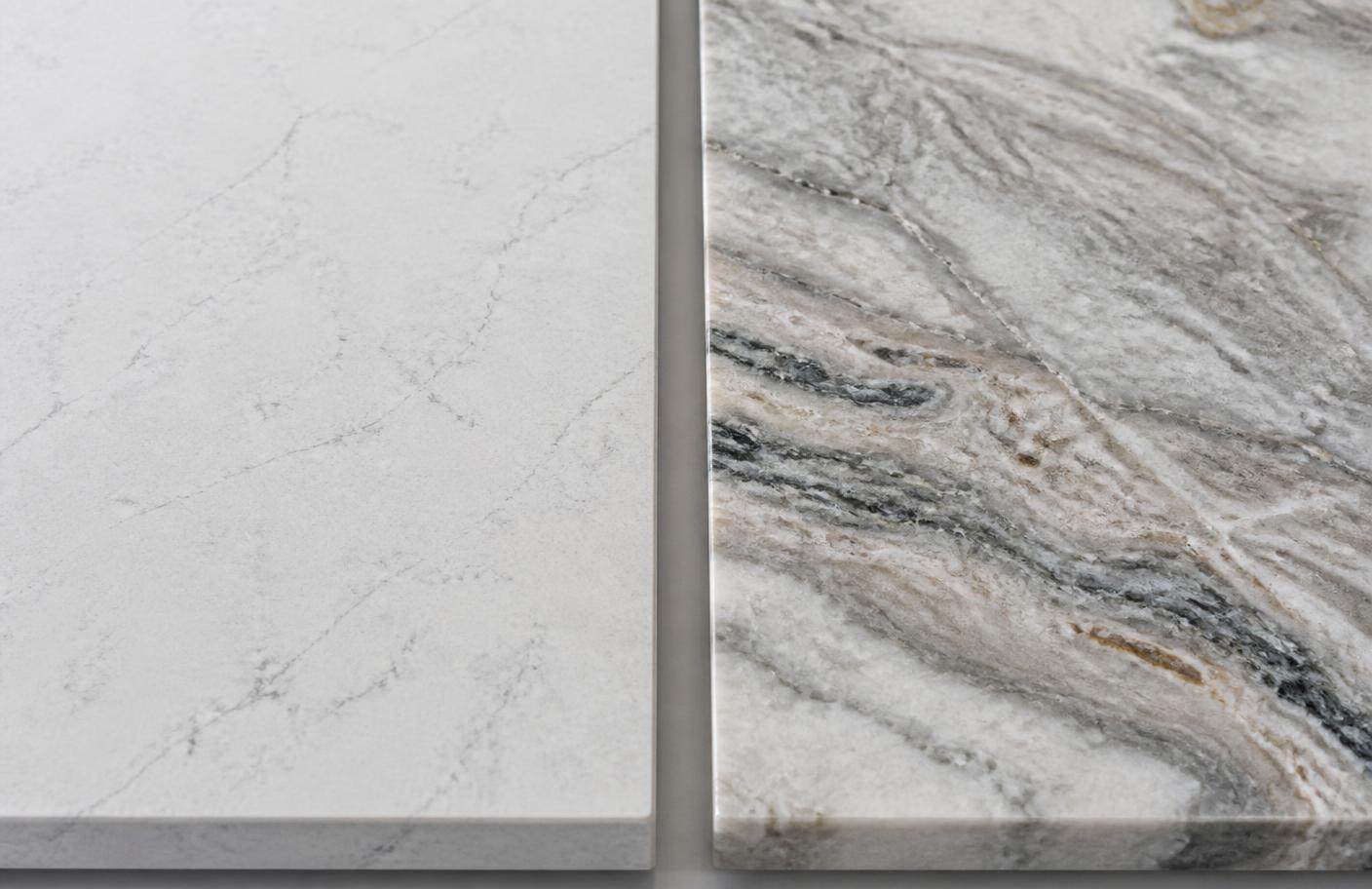
Quartz
- Engineered
- More visually predictable
- Nonporous in many products
- Usually no sealing
- Protect from high or sustained heat
- Broad price and pattern range
Quartzite
- Natural stone
- Unique slab movement
- Often selected in person as full slabs
- Stone-specific sealing and care may apply
- Generally stronger heat tolerance
- Often chosen for a high-end natural look
The better choice depends on whether the homeowner values consistency and lower routine maintenance or natural variation and slab character.
What About a Waterfall Countertop?
A waterfall countertop continues vertically down the side of an island or cabinet run.
It can create a strong architectural feature, but it affects more than appearance.
Plan for:
- Additional slab material
- Mitered fabrication
- Pattern alignment
- Seam location
- Floor and cabinet tolerances
- Protection of exposed edges
- Outlet and code coordination where applicable
- Seating and overhang details
A waterfall edge works best when it supports the overall design. It should not be added merely because it appears in inspiration photographs.
In a smaller or traditional kitchen, a finished cabinet panel or furniture-style island may fit the home better. In a modern open kitchen, a carefully matched waterfall can visually anchor the room.
Full-Height Slab Backsplash Versus Tile
Using the countertop material as a full-height backsplash can reduce grout lines and create a continuous appearance.
It also affects:
- Slab quantity
- Vein layout
- Outlet placement
- Switch placement
- Hood and cabinet installation
- Template sequence
- Fabrication cost
- Wall flatness
Tile offers more pattern, texture, and replacement flexibility. Slab backsplash offers visual continuity and fewer joints.
Neither is automatically better.
Seams, Slab Size, and Pattern Matching
A large island may not fit on one slab.
Before choosing material, ask the fabricator:
- What are the available slab dimensions?
- Where are seams likely?
- Can the island be made from one slab?
- How will veins meet at seams?
- How will a waterfall edge align?
- Are bookmatching or special layouts possible?
- How much material waste will the design create?
- Will the homeowner approve the slab layout?
A countertop with beautiful material and a poorly planned seam can be disappointing. Fabrication planning is part of material selection.
Edge Profiles and Apparent Thickness
The edge changes how the material looks and behaves.
Common approaches include:
- Eased edge
- Beveled edge
- Bullnose or half-bullnose
- Ogee or decorative profiles
- Mitered built-up edge
- Thin porcelain profile
A simple eased edge can feel current and clean. A decorative edge may fit a traditional kitchen. A mitered edge creates a thicker visual appearance but requires skilled fabrication and careful corner alignment.
The edge should match the cabinet style, home, and level of finish.
Sink and Cooktop Cutouts
Cutouts create some of the most vulnerable areas in any countertop.
Plan for:
- Sink type and exact model
- Faucet holes
- Soap dispenser or air switch
- Water filtration
- Cooktop specifications
- Clearances
- Reinforcement
- Cabinet support
- Dishwasher venting or mounting
- Seam proximity
Do not change a sink or cooktop after the template without confirming the fabrication impact.
How Cabinet Color Changes the Countertop
The countertop does not exist by itself.
A warm white surface can appear gray beside cream cabinets. A dramatic veined slab can compete with heavily grained wood. A dark countertop can look elegant in strong natural light and oppressive in a dim room.
Review samples with:
- Actual cabinet door
- Flooring sample
- Backsplash option
- Hardware finish
- Paint color
- Lighting temperature
- Appliance finish
View them in the room at different times of day.
Use the UpdateSTL Cabinet Estimator to understand the cabinet budget before spending the entire finish allowance on the countertop. Layout questions belong in the same conversation — see the kitchen triangle rule and open kitchen concept ideas.
Match the Countertop to the Level of Finish
A premium natural stone may make sense in a high-value forever home.
A durable quartz or granite may fit a broad range of updated kitchens.
A practical laminate or solid surface may be the right answer for a rental, resale preparation, or budget-controlled remodel.
The cheapest material can underfinish the home.
The most expensive material can overbuild it.
The right material supports the property, neighborhood, budget, and reason for remodeling.
Read What Does Level of Finish Mean in a Remodel? before deciding where the countertop belongs in the overall investment. If you are still selecting a builder, review how to hire a remodeling contractor in St. Louis.
Choose by Household, Not by Hype
Busy family with low maintenance priority
Consider quartz, porcelain, granite selected for manageable care, or solid surface.
Serious cook with frequent heat exposure
Consider natural stone or porcelain based on specific product guidance, while still using safe protection and respecting seams and edges.
Homeowner who wants one-of-a-kind natural movement
Consider quartzite, granite, marble, soapstone, or selected natural stone.
Budget-conscious remodel
Consider laminate, selected granite, entry quartz, butcher block accent areas, or solid surface depending on local availability and project needs.
Historic or character-rich St. Louis home
Consider soapstone, marble, granite, butcher block, or quieter quartz and quartzite designs that support the architecture rather than fighting it.
Contemporary open kitchen
Consider quartz, quartzite, porcelain, full-height slab backsplash, or a carefully planned waterfall countertop.
Questions to Ask Before Ordering
- Is this natural or engineered material?
- Must I select the actual slab?
- Does it require sealing?
- What cleaners are approved?
- What heat protection is required?
- What can void the warranty?
- Where will seams be located?
- Is the island one slab or multiple pieces?
- How will the pattern align at seams and waterfalls?
- What edge profiles are appropriate?
- What support is needed for overhangs?
- Are sink and cooktop models final?
- Who approves the slab layout?
- How will the backsplash be coordinated?
- What happens if a slab is damaged or unavailable?
How Countertops Affect the Kitchen Timeline
Countertops are usually not installed immediately after cabinets.
For many stone and engineered surfaces, the cabinets must first be installed, leveled, secured, and ready for template. Sink, cooktop, faucet, edge, seam, and overhang decisions must be confirmed. The fabricator then measures, fabricates, and schedules installation.
This creates a dependency in the kitchen schedule.
Read How Long Does a Kitchen Remodel Take? before setting expectations around the cabinet, template, fabrication, backsplash, plumbing, and appliance sequence.
The Bottom Line
The best kitchen countertop material is not a universal product.
Quartz offers consistency and low routine maintenance.
Quartzite offers natural depth and unique movement.
Granite offers durable natural variety.
Marble offers timeless beauty with visible patina.
Porcelain offers strong performance and thin-slab design possibilities.
Soapstone offers heat resistance and character.
Butcher block brings warmth.
Solid surface offers seamless repairable possibilities.
Laminate controls cost.
Concrete creates a custom artisan result.
Every material asks the homeowner to accept something in exchange for its strengths.
Choose the tradeoff deliberately.
How UpdateSTL.com Helps Coordinate the Entire Selection
This is where UpdateSTL.com can help.
A countertop should be selected with the cabinet plan, appliance locations, sink, backsplash, flooring, lighting, level of finish, fabrication sequence, and project budget in view.
UpdateSTL.com, powered by Wehmeier and Son, helps St. Louis homeowners connect those decisions before the kitchen is built.
The goal is not simply to pick a beautiful slab.
It is to make the entire kitchen work together.
Review the Kitchen Remodeling St. Louis: Ultimate 2026 Guide, use the Cabinet Estimator, and bring actual material questions into the planning process.
Countertop Questions
Is quartz or quartzite better for a kitchen?
Neither is universally better. Engineered quartz offers visual consistency and, in many products, no routine sealing. Natural quartzite offers unique slab movement and generally stronger heat tolerance, but requires stone-specific care and in-person slab selection. Choose based on whether you value consistency and low maintenance or natural variation.
Which countertop requires the least maintenance?
Nonporous surfaces such as many quartz, porcelain, and solid-surface products typically require the least routine maintenance because they generally do not need sealing. Care requirements still vary by product, so follow the manufacturer's instructions for the exact surface selected.
Which countertop is most heat resistant?
Natural stones such as granite, quartzite, and soapstone, along with many porcelain and sintered surfaces, generally handle heat better than resin-based materials like quartz, solid surface, and laminate. Even so, trivets and hot pads are wise on every surface, and product guidance controls.
Does quartz need to be sealed?
Most engineered quartz products are nonporous and do not require routine sealing. Confirm the requirement with the manufacturer's care instructions and warranty for the specific product.
Does quartzite need to be sealed?
Sealing is often recommended for natural quartzite, but the recommendation depends on the specific stone. Ask the stone supplier or fabricator to identify the slab accurately and provide care guidance for it.
Is butcher block practical around a sink?
It can be, but wood moves with moisture. Sink cutouts, seams, dishwashers, and wet areas require careful fabrication and ongoing maintenance. The finish system determines whether the surface is intended for direct cutting or decorative use.
Are porcelain countertops durable?
Many porcelain and sintered surfaces offer strong heat, scratch, and stain resistance. They are also very hard, which can make edges vulnerable to impact or chipping if mishandled, and fabrication requires appropriate equipment and experience.
Is marble a bad choice for a kitchen?
Not necessarily. Marble can etch from acids and can stain or scratch, and sealing does not prevent etching. Homeowners who accept patina as part of the material often love it for decades; homeowners who expect it to remain unchanged may be disappointed.
What is a waterfall countertop?
A waterfall countertop continues the surface vertically down the side of an island or cabinet run. It requires additional slab material, mitered fabrication, pattern alignment, careful seam placement, and coordination with floors, cabinets, and outlets.
When are countertops measured during a remodel?
For many stone and engineered surfaces, templating happens after the base cabinets are installed, leveled, and secured, with the sink, faucet, and cooktop models confirmed. Fabrication and installation follow, which creates a natural dependency in the kitchen schedule.
Continue Planning Your Kitchen
Kitchen Remodeling St. Louis: The Ultimate 2026 Guide
Costs, layout, cabinets, countertops, permits, and planning in one place.
Read the articleHow Long Does a Kitchen Remodel Take?
The full planning and construction timeline, phase by phase.
Read the articleThe Kitchen Triangle Rule
Workflow, aisles, islands, and zones — how the kitchen actually works.
Read the articleOpen Kitchen Concept Design Ideas for St. Louis Homes
Walls, islands, ventilation, storage, noise, and structural planning.
Read the articleChoose the Countertop as Part of the Kitchen — not Apart From It
Let's coordinate the cabinets, appliances, sink, backsplash, lighting, fabrication, and finish level before the order is placed.
Sources and Further Reading
- NKBA, 2026 Kitchen Trends Report
- Houzz, 2026 U.S. Kitchen Trends Study
- Natural Stone Institute, Natural Stone Care
- Natural Stone Institute, Countertop Considerations
- MSI, What Are Quartz Countertops?
- MSI, Quartz Buying and Care Guidance
- Caesarstone, Porcelain Surfaces
- Corian, Solid Surface Features and Benefits
- Formica, Laminate Care